


Microsoft Fabric
Unify your data, analytics, and reporting in one platform so your business can make smarter decisions faster.
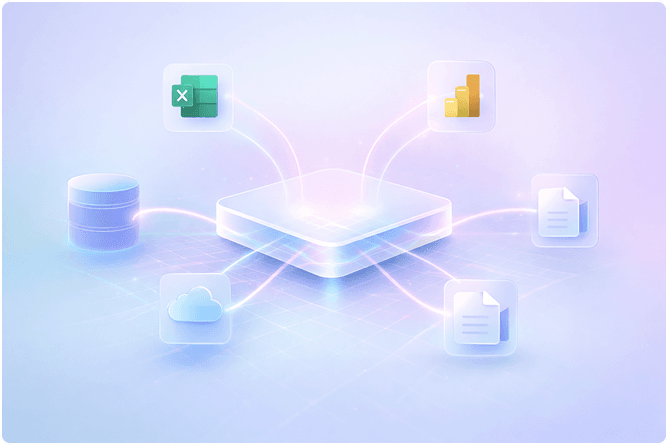
What’s slowing your business down?
Most businesses don’t have a data shortage — they have a data fragmentation problem. The result is slow decisions, high IT overhead, and missed opportunities.
Fragmented Tools Are Increasing IT Costs
Your team is paying for separate ETL tools, a data warehouse, a BI platform, and ML infrastructure — often with overlapping functionality. Managing licensing, integration, and upgrades is a full-time job.
Your Data Trapped in Silos
Finance uses one system, operations another, HR a third. No one has a full picture. Reconciling data across teams takes days — and the answer is always outdated by the time it arrives.
Governance Is Patchy and Risky
Sensitive data lives in spreadsheets, uncontrolled SharePoint folders, and ad-hoc exports. Meeting regulatory requirements — GDPR, NIS2, DORA — is impossible without centralised control.
What If All Your Data Worked Together?
Microsoft Fabric brings data integration, analytics, and business intelligence into one unified platform.
Instead of managing disconnected tools, your teams work from a single trusted data foundation that turns information into insights faster.
What Microsoft Fabric Makes Possible
Microsoft Fabric brings together integration, analytics, governance, and AI in one environment designed to simplify your entire data lifecycle.
Unified Data Platform

Microsoft Fabric combines data integration, analytics, and reporting into a single platform. Instead of managing multiple tools, your teams can work from one unified data environment.
Real-Time Analytics

Fabric allows organizations to process and analyze data in real time, helping teams respond faster to changes and make more informed decisions.
Built-In BI

With native integration with Power BI, Fabric makes it easy to visualize data, track performance, and share insights across the entire organization.
End-to-End Data Workflows

Fabric supports the entire data journey—from collecting and preparing data to analyzing and visualizing it—within a single integrated platform.
Governance and Security

Fabric includes built-in governance, security, and compliance tools that help organizations manage sensitive data while meeting regulatory requirements.
AI-Ready Data Foundation

Fabric stores data in open formats and integrates with AI tools, enabling organizations to build machine learning models and AI-powered insights directly on their analytics platform.
How Microsoft Fabric Works
All data workloads run on the same platform and share a single data foundation.
Microsoft Fabric
One platform for your entire data lifecycle

Data factory

Analytics

Databases

Real-time intelligence

IQ

Power BI

OneLake
Microsoft Fabric Architecture
Microsoft Fabric brings together multiple analytics capabilities within a single Software-as-a-Service platform. Each workload—such as Data Factory, Analytics, Databases, Real-Time Intelligence, AI (IQ), and Power BI—is designed for a different stage of the data lifecycle, from ingesting and processing data to analyzing and visualizing insights. All of these workloads operate on top of OneLake, the unified data lake that allows data to be stored once and securely accessed across the entire platform.
One lake
OneLake is the unified data lake built into Microsoft Fabric, designed to store all your organization’s analytics data in one place. Just like OneDrive simplifies file storage, OneLake provides a single, shared data foundation for every team, tool, and workload.
One Data Lake for the Entire Organization

OneLake provides a single, unified data lake for all teams and departments. Instead of managing multiple data lakes across systems, your organization works from one centralized data foundation.
One Copy of Data, No Duplication

Data stored in OneLake can be used by multiple tools and analytics engines without copying or moving it. Reducing storage costs amd eliminating duplication.
Built-in Governance and Protection
All data in OneLake is automatically protected by tenant-level security, compliance, and access policies. This ensures consistent governance across your entire data environment.
Connect Data Across Systems

OneLake shortcuts allow teams to connect data from other workspaces, clouds, or external sources like ADLS, Amazon S3, or Dataverse without moving the data.
Open Data Formats for Flexibility

OneLake stores data using open standards like Delta Parquet, making it compatible with tools such as SQL, Apache Spark, and Power BI.
Disaster Recovery For Your Data

Features like soft delete and disaster recovery help protect your data from accidental deletion or infrastructure failures, ensuring reliability and business continuity.
Don’t Let Fragmented Data Hold Your Business Back
Organizations are already moving toward unified analytics platforms. Let Pepas Cloud help you make the transition with Microsoft Fabric.